
Air Care repairs, replaces and maintains gas furnaces, heat pumps and thermostats for homes across Star, from rural acreage and ranch properties to new subdivisions along State Street and Star Road, & more. We are a licensed Idaho HVAC contractor, and emergency service is available 24/7. Call (208) 939-2566 to schedule service.
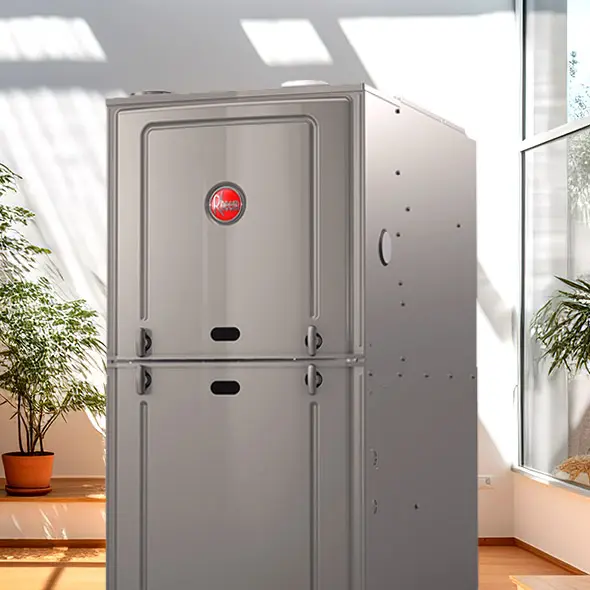
 Rheem equipment installed and serviced
No heat? Call now, or schedule a fall tune-up before the first freeze.
Signs your furnace needs repair
Cold, clear nights and inversion layers can hold freezing temperatures over Star for days, and most furnace failures land on the coldest night of the year, when your system is working its hardest. Call (208) 939-2566 when you notice:
- Cold air from the vents while your furnace runs
- An inducer fan that runs while the burners never light
- A click at startup, then silence
- Groaning, squealing or a cabinet that shakes when the blower starts
- Burners that keep shutting off before your home warms up
- A yellow burner flame instead of a blue one
How we diagnose and repair a furnace
We repair every major make and model of heating equipment, in homes from a classic farmhouse near the Boise River to a contemporary home in a new subdivision, and we diagnose with digital manometers, multimeters and combustion analyzers.
Igniters and flame sensors
Hot surface igniters heat to over 2,000 degrees Fahrenheit in seconds, and over time they crack or burn out. If the inducer fan runs but the burners never light, or you hear a click followed by silence, the ignition system is the usual cause. Our technicians carry replacement igniters and control boards. We also clean and align the flame sensor, a small rod that collects oxidation and makes your furnace think the burners never lit.
Blower motors and capacitors
A failing blower motor groans, squeals, shakes the cabinet or will not start, and without airflow the heat exchanger overheats until the high-limit switch shuts your furnace down. We measure the motor's amperage draw against the manufacturer's rating, test the run capacitor that starts it, and can often replace a seized motor on the spot.
Limit switches and safety controls
The high-limit switch shuts off the burners when the air inside your furnace gets too hot, usually because of a clogged filter, closed vents or restricted ductwork. A switch that trips again and again wears out. We test every safety control for continuity and voltage, and when a limit switch is tripping we find the cause before we replace it, so the new switch lasts.
Heat exchangers and carbon monoxide
Years of heating and cooling can crack the seams of a heat exchanger, and a crack can let carbon monoxide into the air you breathe. We inspect the heat exchanger with a camera for cracks, rust and soot, and run a combustion analysis that measures CO in the flue gas and the supply air. If we find a cracked heat exchanger or a CO leak, we shut the furnace down and tag it so it is not run until it is repaired or replaced.
Repair or replace
A gas furnace in the Star climate typically lasts 15 to 20 years. If yours is near that age, needs an expensive repair to the blower or control board, or keeps pushing your gas bill up, we show you the repair-versus-replace math. When a repair costs half the price of a new system or more and the unit is out of warranty, replacement is usually the better choice. So is a furnace that needs a different repair every winter.
Efficiency is rated in AFUE, the share of the gas you buy that becomes heat in your home. Older furnaces in Star often run at 60 to 70 percent. New standard-efficiency furnaces start at 80 percent, and high-efficiency condensing furnaces reach up to 98 percent. Single-stage furnaces run on or off; two-stage furnaces run on low through most of the winter and switch to high in a cold snap; modulating furnaces adjust their output in steps as small as 1 percent and hold your temperature within a fraction of a degree. We help you calculate the long-term savings of a high-efficiency model.
How we install
We size every new furnace to your home's square footage, attic and wall insulation, window quality and the direction your home faces. An oversized furnace short cycles and leaves hot and cold spots; an undersized one runs all night and never reaches the set temperature.
Your new furnace goes in level and supported to cut vibration and noise. For a high-efficiency condensing furnace we run dedicated PVC intake and exhaust pipes and make sure the acidic condensate drains properly. We check the gas connection for leaks, install a sediment trap (drip leg) ahead of the gas valve, verify electrical polarity and grounding, and fit sheet metal transitions to your supply and return plenums sealed with mastic. We handle the permit and the final safety check.
Fall tune-ups
A precision tune-up every fall is how you avoid a no-heat night in January. We test for carbon monoxide, inspect the flue for corrosion and blockages such as bird nests, clean the burners and the flame sensor, measure the temperature rise against the manufacturer's range, check the gas pressure at the manifold, and check the blower capacitor and amp draw. If a part is drifting out of spec, you hear about it before it fails.
Heat pumps and dual fuel
A heat pump moves heat from the outdoor air into your home and keeps working below freezing. For many Star homes we pair one with a gas furnace as a dual-fuel system: the heat pump carries the milder days of fall and early winter, and the furnace takes over when the temperature drops into the teens.
Thermostats and air quality
We install, wire and program Google Nest and Ecobee smart thermostats, including a C-wire for constant power, and we fix blank screens, loose connections and thermostats that read the wrong temperature. For a home with a hot upstairs and a cold downstairs, we install zoning: motorized dampers in your ductwork, each zone on its own thermostat.
Heating your home through a Star winter dries out the air inside. Our whole-home humidifiers connect to your furnace and hold indoor humidity in the 35 to 45 percent range, and our air filtration systems catch the dust and pollen that stay indoors through a long winter.
Star questions
What is the best type of heating system for a home in Star?
Most homes in Star rely on forced-air gas furnaces due to their ability to heat spaces quickly during our cold winters. However, if your property does not have access to natural gas, a high-efficiency propane furnace or a cold-climate heat pump are excellent alternatives. Dual Fuel systems (Heat Pump + Gas/Propane Furnace) are increasingly popular for maximizing efficiency in our specific climate.
Why is my furnace making a clicking noise but not turning on?
A clicking noise followed by silence usually indicates an issue with the ignition system. The furnace is trying to light the burners but failing. This could be due to a faulty igniter, a dirty flame sensor, or a gas supply issue. The system eventually locks out for safety. You will need a professional Star furnace repair technician to diagnose and fix the specific component.
How often should I change my air filter in Star?
Due to the amount of new construction and agricultural activity in Star, dust levels can be higher than average. We recommend checking your furnace filter every 30 days during the heating season. A dirty filter restricts airflow, which can cause the heat exchanger to overheat and crack. If the filter looks gray or clogged, replace it immediately to protect your equipment.
Can a heat pump handle the freezing temperatures in Star?
Yes, but with caveats. Modern "cold climate" heat pumps are efficient down to very low temperatures. However, when Star experiences inversion layers with single-digit temps, a heat pump may struggle to keep up or rely heavily on expensive electric heat strips. This is why we often recommend a backup gas or propane furnace (Dual Fuel) for those coldest days.
Is it normal for my furnace to smell like burning dust?
If you smell burning dust when you turn your heater on for the first time in the fall, that is normal. It is simply dust that settled on the heat exchanger burning off. The smell should dissipate within 30 minutes. If the smell persists, or if you smell burning plastic or a rotten egg odor (gas), turn off the system and call for emergency heating service immediately.
How long does a furnace installation take in Star?
A standard Star furnace replacement typically takes one day to complete. If the job involves extensive ductwork modification, gas line relocation, or installing a new zoning system, it may take longer. We always aim to get your heat back up and running before evening falls.
Nearby
Service hub: Furnace repair and replacement


